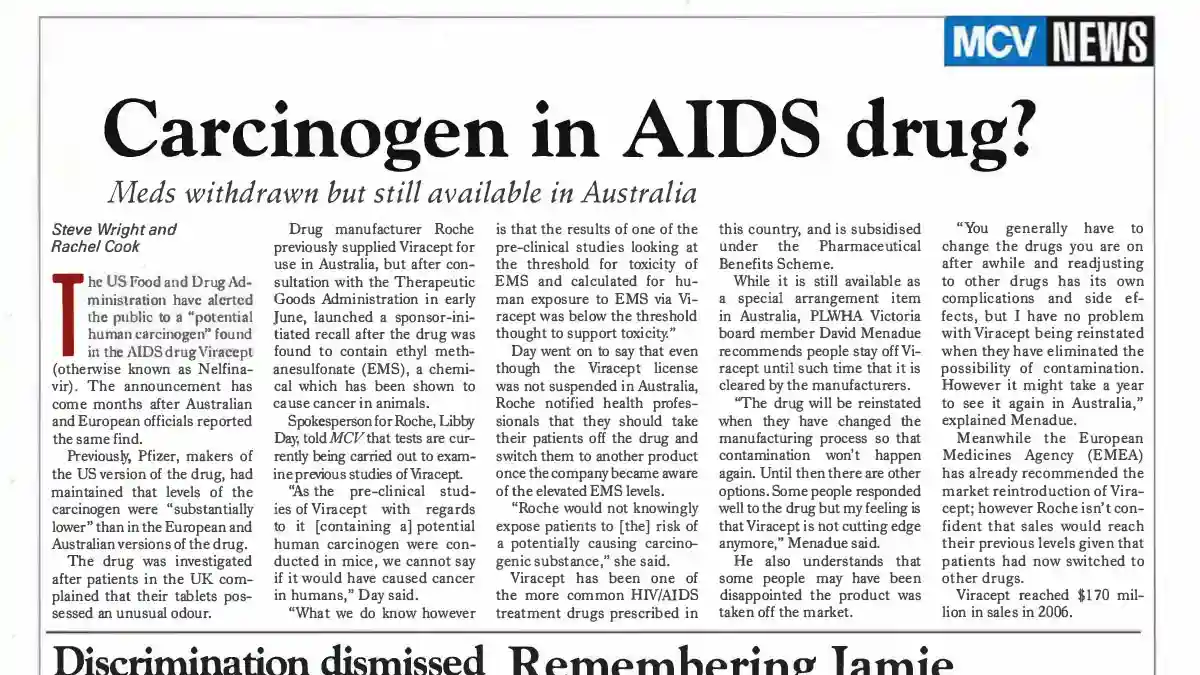
This article was first published in print magazine Melbourne Community Voice (MCV). It appeared in Issue 353, and was co-authored with Rachel Cook.
The US Food and Drug Administration has alerted the public to a “potential human carcinogen” found in the AIDS drug Viracept (otherwise known as Nelfinavir). The announcement has come months after Australian and European officials reported the same find.
Previously, Pfizer, makers of the US version of the drug, had maintained that levels of the carcinogen were “substantially lower” than in the European and Australian versions of the drug.
The drug was investigated after patients in the UK complains that their tablets possessed an unusual odour.
Drug manufacturer Roche previously supplied Viracept for use in Australia, but after consultation with the Therapeutic Goods Administration in early June, launched a sponsor-initiated recall after the drug was found to contain ethyl methanesulfonate (EMS), a chemical which has been shown to cause cancer in animals.
Spokesperson for Roche, Libby Day, told MCV that tests are currently being carried out to examine previous studies of Viracept.
“As the pre-clinical studies of Viracept with regards to it [containing a] potential human carcinogen were conducted in mice, we cannot say if it would have caused cancer in humans,” Day said.
“What we do know however is that results of one of the pre-clinical studies looking at the threshold of toxicity of EMS and calculated for human exposure to EMS via Viracept was below the threshold thought to support toxicity.”
Day went on to say that even though the Viracept license was not suspended in Australia, Roche notified health professionals that they should take their patients off the drug and switch them to another product once the company become aware of the elevated EMS levels.
“Roche would not knowingly expose patients to [the] risk of a potentially causing carcinogenic substance,” she said.
Viracept has been one of the more common HIV/AIDS treatment drugs prescribed in this country, and is subsidised under the Pharmaceutical Benefits Scheme.
While it is still available as a special arrangement item in Australia, People Living with HIV/AIDS Victoria board member David Menadue recommends people stay off Viracept until such time that it is cleared by the manufacturers.
“The drug will be reinstated when they have changed the manufacturing process so that contamination won’t happen again. Until then there are other options. Some people responded well to the drug but my feeling is that Viracept is not cutting edge anymore,” Menadue said.
He also understands that some people may have been disappointed the product was taken off the market.
“You generally have to change the drugs you are on after awhile and readjusting to other drugs has its own complications and side effects, but I have no problem with Viracept being reinstated when they have eliminated the possibility of contamination. However it might take a year to see it again in Australia,” explained Menadue.
Meanwhile the European Medicines Agency has already recommended the market reintroduction of Viracept; however Roche isn’t confident that sales would reach their previous levels given that patients had now switched to other drugs.
Viracept reached $170 million in sales in 2006.
