This article was first published in The Sheaf, the print newspaper of The University of Saskatchewan. It was an article inside Volume 92, Issue 29.
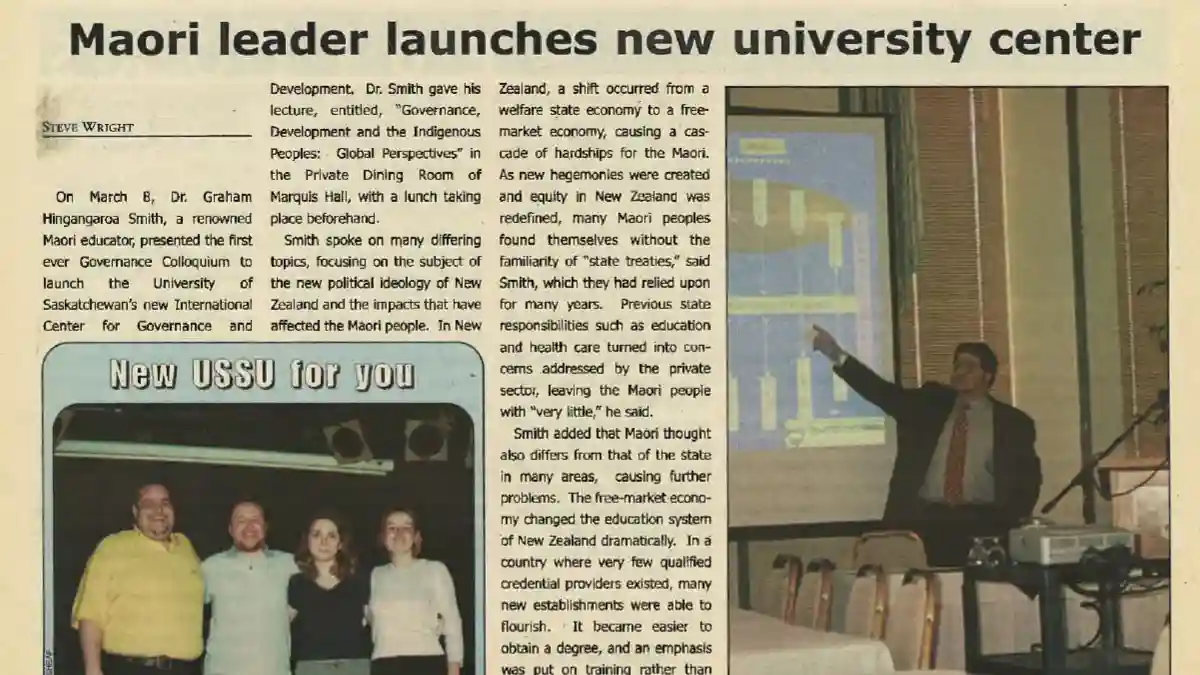
On March 8, Dr. Graham Hingangaroa Smith, a renowned Maori educator, presented the first ever Governance Colloquium to launch the University of Saskatchewan’s new International Center for Governance and Development. Dr. Smith gave his lecture, entitled, “Governance, Development and the Indigenous Peoples: Global Perspectives” in the Private Dining Room of Marquis Hall, with a lunch taking place beforehand.
Smith spoke on many differing topics, focusing on the subject of the new political ideology of New Zealand and the impacts that have impacted the Maori people. In New Zealand, a shift occurred from a welfare state economy to a free-market economy, causing a cascade of hardships for the Maori. As new hegemonies were created and equity in New Zealand was redefined, many Maori peoples found themselves without the familiarity of “state treaties,” said Smith, which they had relied upon for many years. Previous state responsibilities such as education and health care turned into concerns addressed by the private sector, leaving the Maori people with “very little,” he said.
Smith added that Maori thought also differs from that of the state in many areas, causing further problems. The free-market-economy changed the education system of New Zealand dramatically. In a country where very few qualified credential providers existed, many new establishments were able to flourish. It became easier to obtain a degree, and an emphasis was put on training rather than learning; knowledge was now seen as a tool to obtain financial success. The Maori did not agree with this, as knowledge to them was seen as being a gift that should be used to benefit the public good, explained Smith.
A solution, he explained, would be to let the Maori be self-governing; Smith also expressed his desire for other cultures to have this power as well. Using the example of the Maori people, Smith was able to explain many differing concerns such as this that are taking place on a global level.
In the lecture, he explained that the new university center will be “incorporating the notion of globalization” into its everyday operations, and will be looking at a number of differing interm1tional governing and development concerns.
As the Pro Vice-Chancellor (Maori) of the University of Auckland in New Zealand, Smith holds the most senior Maori position of any university in that country. He is “currently responsible for envisioning, coordinating and positioning Maori education” at the university, “using the principles of Kaupapa Maori philosophy,” declared a recent press statement.
In his career, Smith has “been instrumental in establishing the Te Kohanga Reo language nests,” which have made it possible for the teaching of the language in all school levels in New Zealand, explains the release. His research focuses on Indigenous peoples worldwide, having tremendous expertise in the “promotion and protection issues of Indigenous knowledge,” and lectures widely on Maori and Indigenous education.
Smith has previously visited the University of Saskatchewan as a speaker and delegate to the International Summer Institute on the Cultural Restoration of Indigenous Peoples in 1996.
